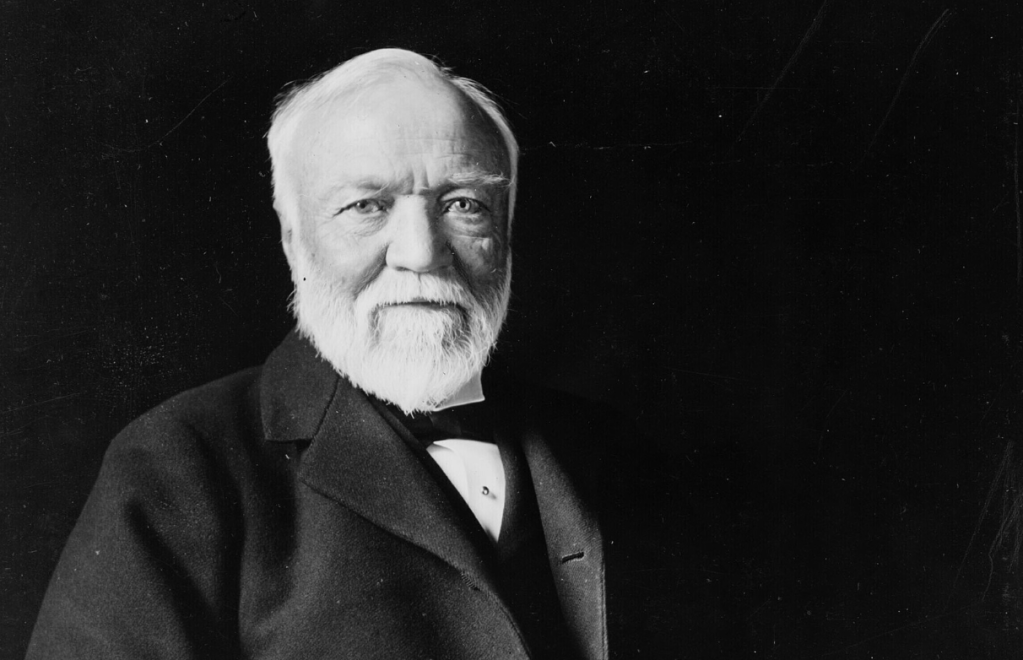
I don’t agree with the common critique from the left that billionaires are inherently bad.
Many of the 19th and early-20th-century millionaires (who would be considered billionaires today) did some good, liberal, or reform-leaning work for their time. This is not to say that these folks ONLY did “good” things; they also did some bad things. Most humans are a mass of contradictions, sadly!
Here are 5 of them who took some reformist / liberal-leaning actions (for their time).
Authored “The Gospel of Wealth” (1889), arguing:
- Extreme inequality is acceptable only if the rich actively redistribute wealth.
- Wealth should be used for public goods, not inheritance.
- Opposed hereditary dynastic wealth (very unusual among elites at the time).
Labor / economics:
- Supported labor arbitration (not unions per se, but mediation instead of repression)
- Backed shorter working hours in principle (though not consistently in practice)
Institution-building:
- Funded 2,500 free public libraries (major expansion of mass literacy access)
Established:
- Carnegie Mellon University
- Carnegie Institution for Science
- Carnegie Endowment for International Peace
Peace / internationalism:
Advocated for:
- Arbitration treaties instead of war
- Early forms of international governance (pre-UN)
Worker benefits / proto-welfare capitalism:
Introduced:
- Profit-sharing programs
- Employee stock ownership
- Disability benefits
- Pensions
Workplace reform:
- Supported improved working conditions relative to industry norms.
- Promoted internal advancement and training.
Public health and education:
Major donor to:
- University of Rochester
- MIT
- Dental clinics (including for low-income populations)
Access to technology:
Helped democratize photography (Kodak cameras), which had broader cultural implications for access and documentation.
Civil rights:
- Major funder of the NAACP.
- Worked directly with Booker T. Washington.
Education equity:
- Funded 5,000 Rosenwald Schools across the segregated South.
- Built for African-American students systematically excluded from public education.
- Required matching funds from local Black communities, which was an early public-private partnership model.
Public health:
- Funded healthcare initiatives for underserved Black communities in the South
Philanthropic philosophy:
- Opposed perpetual foundations.
- Required his foundation to spend down its assets (not exist indefinitely)
- Focused on systemic inequality, not just charity.
Public health (systemic impact):
- Funded the Rockefeller Foundation
- Major campaigns against hookworm, yellow fever, and malaria.
- Helped build early global public health infrastructure.
- Created the Rockefeller Institute for Medical Research (now Rockefeller University).
Education reform:
Funded:
- University of Chicago (turned into a top-tier research institution)
- Spelman College
- Supported modernization of medical education (aligned with reforms like the Flexner Report)
Religious / moral framing of wealth:
- Promoted stewardship and giving through Baptist ethics.
- Helped normalize large-scale philanthropy as a social obligation.
Jane Stanford (and the Stanford fortune tied to Leland Stanford)
Education access:
Co-founded Stanford University with:
- A mission to educate broadly, not just elites.
- Early inclusion of women (coeducational from the start, which was progressive for the time)
Tuition policy:
- Initially was tuition-free, reflecting a quasi-public education ideal.
Institutional mission
Emphasis on:
- Practical education (engineering, sciences)
- Public service orientation.

