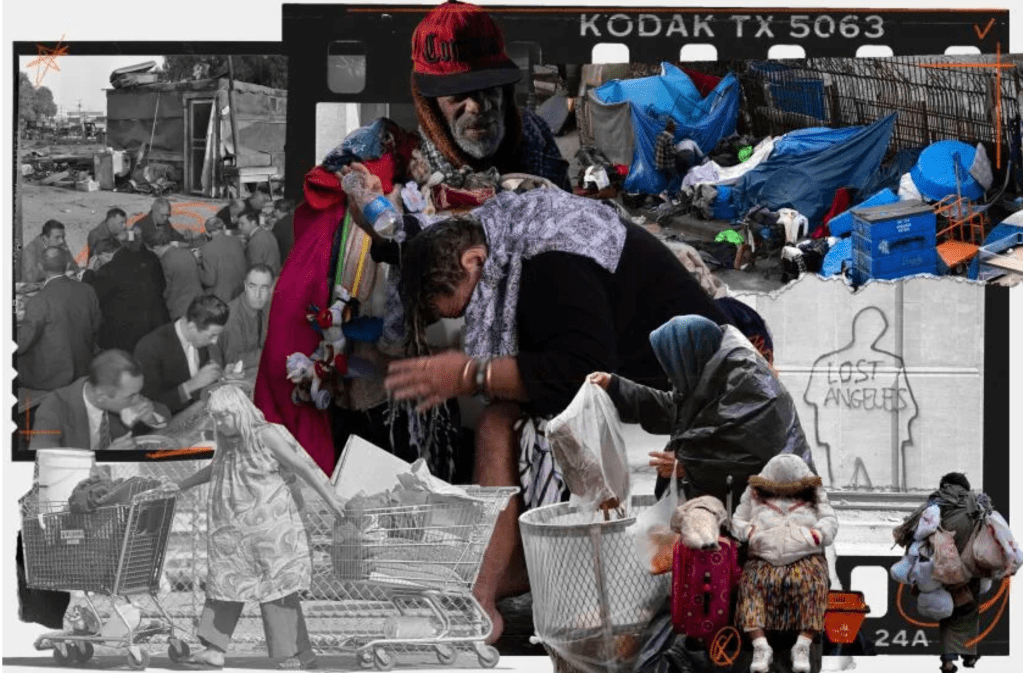
Someone finally wrote the definitive longform piece about exactly how the Los Angeles area became the homeless capital of the US. This fantastic new article traces 70 years(!) of bad decisions by electeds and non-electeds.
Kids shouldn’t be allowed to graduate high school without reading this.
I wrote a summary of the article…
1940s: L.A. bulldozed its shantytowns.
In an effort to modernize its image, the city forcibly cleared Depression-era encampments, destroying informal housing communities without offering alternatives, criminalizing poverty from the start.
Early 1950s: Public housing was canceled due to anti-communist panic.
At the height of McCarthyism, Los Angeles halted construction of a massive public housing project, planned for the land where Dodger Stadium now sits, because it was deemed “socialistic.” This marked an early ideological rejection of government-led affordable housing efforts.
1960s–1970s: Massive, bipartisan deinstitutionalization of mental health patients.
The state of California closed its large mental institutions like Camarillo and Patton, fulfilling a long-standing bipartisan goal to move away from warehousing people in psychiatric hospitals. But the promised community-based mental health infrastructure was never adequately funded or built, leaving thousands of vulnerable people without care or housing.
1960s–1970s: Urban renewal erased working-class housing.
Redevelopment projects in areas like Bunker Hill destroyed low-income, high-density neighborhoods and replaced them with commercial towers and civic buildings, displacing thousands of residents without adequate replacement housing.
1970s–1980s: Demolition of Single Room Occupancy (SRO) hotels.
Tens of thousands of the city’s cheapest housing units were eliminated or converted into upscale hotels and apartments, removing a critical last step before homelessness for many low-income residents.
1978: Proposition 13 radically cut property taxes, shrinking public budgets.
California voters passed Prop 13, drastically reducing property taxes for existing homeowners and businesses. While this protected some on fixed incomes from losing their homes, it severely limited local government revenues—leaving less money available to address the rising crisis of homelessness.
Late 1970s–1990s: Housing prices exploded while homeownership declined.
Housing prices in L.A. doubled from 1975 to 1979 due to population growth, inflation, and real estate speculation, and doubled several more times after that. Even adjusted for inflation, homes today cost about six times what they did then.
Meanwhile, L.A. became a city of renters. By the late 1960s, the homeownership rate had dropped below 50%, and today it’s only about 30%. Rent skyrocketed too: it rose 50% between 1980 and 1990, exploded after the Great Recession, and now the median is $2,800 (compared to $107 in 1970, around $900 in today’s dollars).
1970s–1990s: Immigration surge and extreme overcrowding.
In the 1970s, large numbers of low-income immigrants arrived from Mexico and Central America, but unlike previous immigration waves, there wasn’t enough housing to absorb them. Families packed into studio apartments, and children slept in shifts.
By 1980, L.A. ranked No. 3 among large U.S. counties for overcrowded housing. By 1990, it was No. 1, and it has remained there ever since. In 1987, the L.A. Times estimated 200,000 people in L.A. County were living in converted garages, often without plumbing, heating, or windows.
1970s–1980s: Deindustrialization and labor market collapse.
L.A. lost at least 75,000 unionized manufacturing jobs in auto and tire factories as industries moved overseas. These were replaced by nonunion, low-wage, part-time jobs in sectors like apparel and electronics.
The entry of women into the labor force further increased competition for increasingly precarious jobs. From 1969 to 1987, the percentage of full-time workers living in poverty nearly doubled. Households that once survived on a single wage now needed two incomes, and still often couldn’t afford rent.
1970s onward: Zoning and environmental regulations blocked new housing.
Homeowner groups launched the “No Manhattanization” movement to block multifamily construction in single-family zones. They used local zoning, permitting, and lawsuits under the California Environmental Quality Act (CEQA) to stop or delay apartment developments.
CEQA, originally meant to protect public health and ecosystems, was repurposed to resist housing growth. (In June 2025, a state law was signed to relax CEQA’s application to housing.)
1980s: Federal disinvestment in affordable housing.
The Reagan administration slashed funding for public housing and rental assistance, leaving cities like L.A. without the resources to build or subsidize low-income housing even as demand grew.
1980s–1990s: “Containment” of homelessness in Skid Row.
Rather than build housing citywide, L.A. leaders concentrated services and unhoused people in Skid Row. This created a zone of tolerated poverty, worsening conditions while shielding wealthier neighborhoods from visible homelessness.
1980s onward: Weak rent control accelerated gentrification and displacement.
Laws like Costa-Hawkins limited rent control and allowed major increases when units turned over. Combined with rising home values, this enabled rapid gentrification and pushed many low-income tenants out.
1998–2005: Not enough new affordable housing to keep pace.
Even as the crack epidemic deepened urban poverty, just 20,000 new affordable units were built during this period, while 9,000 rent-controlled apartments were demolished or converted to condos. The net increase was minimal for a city of 4 million.
1990s–2010s: Criminalization of homelessness expanded.
L.A. passed ordinances that criminalized sleeping in cars, sitting on sidewalks, or pitching tents—relying on policing and incarceration to manage poverty instead of investing in housing or care.
Section 8 voucher system is overwhelmed and stigmatized.
The federal Section 8 program, launched in 1974, became the main rental assistance for low-income tenants. But demand quickly outpaced supply. In 1986, the L.A. waiting list was closed after becoming unmanageable. It briefly reopened in 1989, via a single phone number, and received 180,000 calls in just four days. The list was closed again.
By 2016, some landlords refused to accept vouchers at all, effectively shutting out many families despite eligibility.
2016 onward: Prop HHH passed, but building was slow and expensive.
Voters approved $1.2 billion to build supportive housing through Prop HHH, but progress was painfully slow. Projects ran into delays, lawsuits, and neighborhood opposition, blunting the impact of the measure.
Affordable housing is harder and more expensive to build than it looks.
Affordable housing developers face more burdens than private builders. They must stack five to seven funding sources, comply with stricter design codes, and pay prevailing wages.
In 2008, L.A. had far fewer tax-credit-financed affordable units than New York, Chicago, or Philadelphia, cities with stronger public housing systems.
The cost of building is also driven up by requirements for green construction, disability access, union wages, legal and consultant fees, and rising material costs.
Myth vs. reality: L.A. is not a magnet for the unhoused.
A common belief is that people “flock” to L.A. for the weather, but a 2016 county study found two-thirds of the unhoused had lived in L.A. for at least a year, and 43% for more than five years.
The population is no more transient than those in other cities. The problem isn’t migration, it’s housing.
People fall through the cracks, and there’s nowhere to land
Mental illness, addiction, job loss, racism, any one of these may push someone to the edge. But in L.A., there’s nowhere else to land.
The lack of affordable housing is what makes those crises end in homelessness instead of recovery.
Homelessness in L.A. is the product of decisions.
Homelessness is not innate to Los Angeles like earthquakes or Santa Ana winds. It is the predictable result of public policy.
Every US city has poverty, mental illness, and addiction. What those other cities don’t have, because of different choices, is this many people without homes.
 Things I Find Interesting [aka, the stuff rattling around inside the brain of Torr Leonard]