Whenever you notice some trend in society, especially a gloomy one, you should ask yourself:
“Did previous generations complain about the exact same things?” If the answer is yes, you might have discovered an aspect of human psychology, rather than an aspect of human culture.
I’ve spent a long time studying people’s complaints from the past, and while I’ve seen plenty of gripes about how culture has become stupid, I haven’t seen many people complaining that it’s become stagnant.
In fact, you can find lots of people in the past worrying that there’s too much new stuff.
As Derek Thompson relates, one hundred years ago, people were having nervous breakdowns about the pace of technological change. They were rioting at Stravinsky’s Rite of Spring and decrying the new approaches of artists like Kandinsky and Picasso.
In 1965, Susan Sontag wrote that new forms of art “succeed one another so rapidly as to seem to give their audiences no breathing space to prepare”.
Is there anyone who feels that way now?
Likewise, previous generations were very upset about all the moral boundaries that people were breaking.
Back then, as far as I can tell, nobody was encouraging young Americans to party more. Now they do.
So as far as I can tell, the decline of deviance is not just a perennial complaint.
People worrying about their culture being dominated by old stuff—that’s new.
Lots of the data we have suggest that things started getting more homogenous somewhere between the 1980s and 2000s.
There are a few people who disagree at least with parts of the cultural stagnation hypothesis.
Literature Substacker Henry Oliver reports that “literature is booming”, and music Substacker Chris Dalla Riva is skeptical about stagnation in his industry. The internet ethnographer Katherine Dee argues10 that the most interesting art is happening in domains we don’t yet consider “art”, like social media personalities, TikTok sketch comedy, and Pinterest mood boards.
I’m sure there’s some truth to all of this, but I’m also pretty sure it’s not enough to cancel out the massive trends we see everywhere else.
Maybe I’m missing all the new and exciting things because I’m just not cool and plugged in enough? After all, I’ll be the first to tell you there’s a lot of writing on Substack (and the blogosphere more generally) that’s very good and very idiosyncratic—just look at the winners of my blog competitions this year and last year. But I only know about that stuff because I read tons of blogs. If I were as deep into YouTube or podcasts, maybe I’d see the same thing there, too, and maybe I’d change my tune.
It really does seem like we’re experiencing a decline of deviance, so what’s driving it? Any major social trend is going to have lots of causes, but I think one in particular deserves most of the credit and the blame:
WE CARE MORE ABOUT BEING ALIVE
Life is worth more now. Not morally, but literally. This fact alone can, I think, go a long way toward explaining why our weirdness is waning.
There are, I suspect, two reasons we hold onto life more dearly now.
First: we’re richer. Generations of economic development have put more cash in people’s pockets, and that makes them more willing to pay to de-risk their lives—both because they can afford it, and because the life they’re insuring is going to be more pleasant. But as Linch points out, the value of a statistical life has increased faster than GDP, so that can’t be the whole story.
Second: life is a lot less dangerous than it used to be. If you have a nontrivial risk of dying from polio, smallpox, snake bites, tainted water, raids from marauding bandits, literally slipping on a banana peel, and a million other things, would you really bother to wear your seatbelt?
Once all those other dangers go away, though, doing 80mph in your Kia Sorento might suddenly become the riskiest part of your day, and you might consider buckling up for the occasion.
Our super-safe environments may fundamentally shift our psychology.
When you’re born into a land of milk and honey, it makes sense to adopt what ecologists refer to as a “slow life history strategy”—instead of driving drunk and having unprotected sex, you go to Pilates and worry about your 401(k).
People who are playing life on slow mode care a lot more about whether their lives end, and they care a lot more about whether their lives get ruined.
Everything’s gotta last: your joints, your skin, and most importantly, your reputation. That makes it way less enticing to screw around, lest you screw up the rest of your time on Earth.
I think about it this way: both of my grandfathers died in their 60s, which was basically on track with their life expectancy the year they were born. I’m sure they hoped to live much longer than that, but they knew they might not make it to their first Social Security check.
Imagine how differently you might live if you thought you were going to die at 65 rather than 95. And those 65 years weren’t easy, especially at the beginning: they were born during the Depression, and one of them grew up without electricity or indoor plumbing.
Plus, both of my grandpas were drafted to fight in the Korean War, which couldn’t have surprised them much—the same thing had happened to their parents’ generation in the 1940s and their grandparents’ generation in the 1910s.
When you can reasonably expect your government to ship you off to the other side of the world to shoot people and be shot at in return, you just can’t be so precious about your life.
My life is nothing like theirs was. Nobody has ever asked me to shoot anybody. I’ve got a big-screen TV. I could get sushi delivered to my house in 30 minutes. The Social Security Administration thinks I might make it to 80. Why would I risk all this?
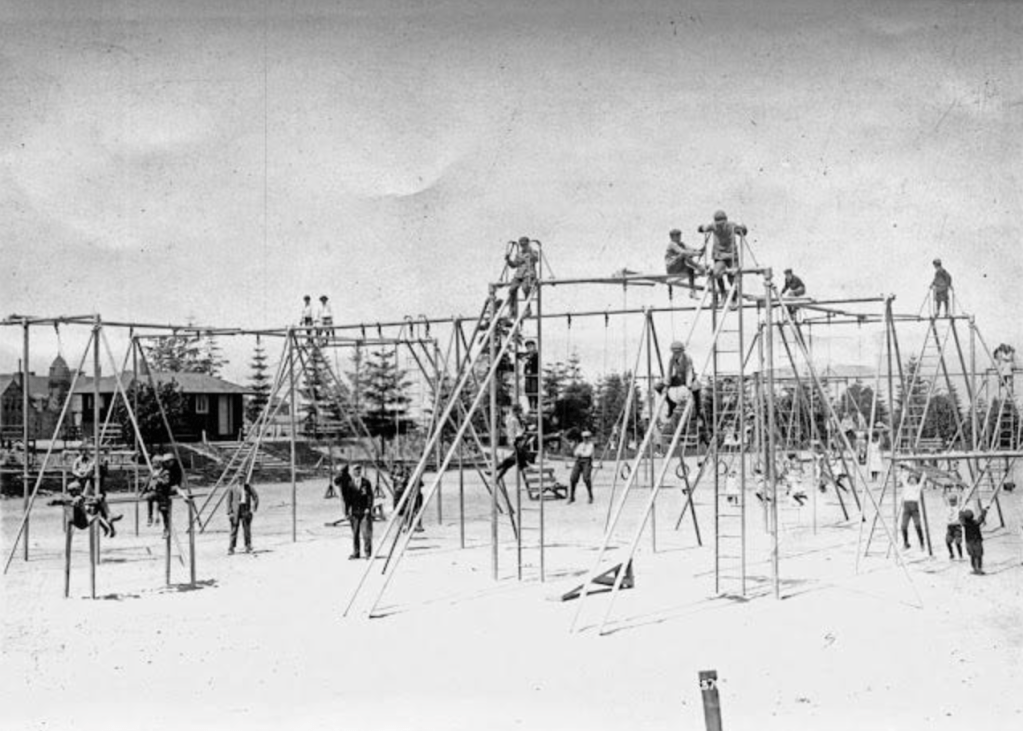
The things my grandparents did casually—smoking, hitching a ride in the back of a pickup truck, postponing medical treatment until absolutely necessary—all of those feel unthinkable to me now. I have a miniature heart attack just looking at the kinds of playgrounds they had back then. [See photo above].
I know life doesn’t feel particularly easy, safe, or comfortable. What about climate change, nuclear war, authoritarianism, income inequality, etc.? Dangers and disadvantages still abound, no doubt. But look, 100 years ago, you could die from a splinter.
We just don’t live in that world anymore, and some part of us picks that up and behaves accordingly.
In fact, adopting a slow life strategy doesn’t have to be a conscious act, and probably isn’t. Like most mental operations, it works better if you can’t consciously muck it up. It operates in the background, nudging each decision toward the safer option.
Those choices compound over time, constraining the trajectory of your life like bumpers on a bowling lane. Eventually, this cycle becomes self-reinforcing, because divergent thinking comes from divergent living, and vice versa.
This is, I think, how we end up in our very normie world. You start out following the rules, then you never stop, then you forget that it’s possible to break the rules in the first place. Most rule-breaking is bad, but some of it is necessary. We seem to have lost both kinds at the same time.
 Things I Find Interesting [aka, the stuff rattling around inside the brain of Torr Leonard]